

Building Water Systems That Last in Ghana
For more than a decade, the Stone Family Foundation (TSSF) has been one of the most consequential partners in Safe Water Network’s Ghana journey — not simply as a funder, but as a thought partner pushing the same question we ask ourselves every day: how do you build water systems that keep delivering long after the ribbon is cut?
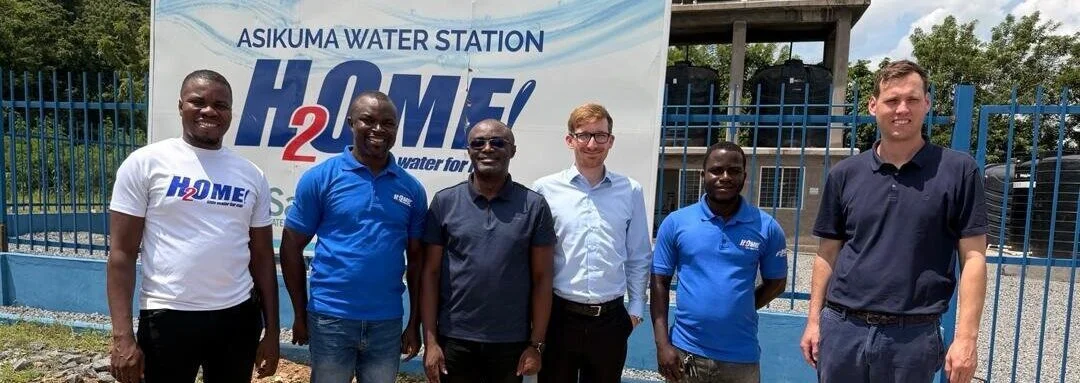
That question brought Ben Shergold, Investment Manager at the Stone Family Foundation, and Tom Chaplin, Managing Director, WASH, at the Foundation back to Ghana this month for a two-day field visit and working session focused on our field operational performance, customer service, and long-term sustainability strategy.
In the field
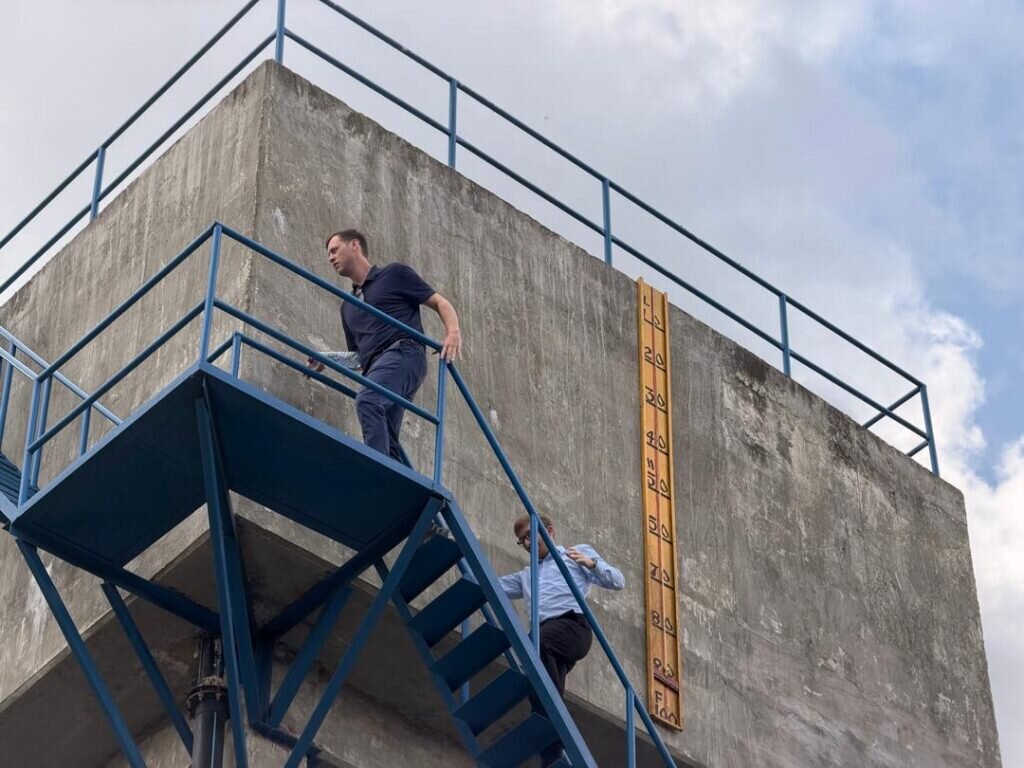
The visit centered on two of our water stations — Asikuma and New Dodi — both roughly a three-and-a-half-hour drive from Accra and sited on the banks of Lake Volta. At each station, the TSSF team met directly with the people who make the model work and the people it serves: field staff running daily operations, and household-connection customers who now have safe water at the tap rather than a long walk away.
The conversations went deep into the operational realities that determine whether a station thrives or struggles — water production and distribution, the customer experience, how we monitor performance, how we manage data, and where automation and real-time monitoring can strengthen service delivery. These are not abstractions. They are the difference between a system that runs reliably for years and one that quietly degrades. Getting them right is the whole game.
Where the partnership is headed
After the field visits, SWN and TSSF sat down to review the performance of our portfolio of water stations, the proposed entity to support the commercial operations of those stations, and the options for financing future growth.

Three priorities surfaced clearly. First, sharpening customer-focused performance indicators, so that the experience of the household at the end of the pipe stays at the center of how we measure success. Second, strengthening operational monitoring systems, so problems are caught and fixed in real time rather than after the fact. And third, developing a long-term strategy that achieves the financial viability of our water stations — the foundation on which everything else depends.
As a next step, over the coming months SWN will work with TSSF to develop a revised five-year business plan to guide the next phase of our growth and impact in Ghana.
A partnership built on viability, not just access
What makes this partnership distinctive is a shared conviction: access alone is not the goal. A water point that fails in three years is not a solution. Both organizations are focused on water systems that are financially sustainable, professionally run, and built to last — increasingly, piped and metered connections that bring safe water directly into homes.
That conviction has a long track record behind it. TSSF first backed SWN’s Ghana expansion in 2015, then helped pioneer solar retrofitting to cut the energy costs that can make or break a station’s economics. Together we launched and scaled the household-connection program, including the Nobewam micro-utility — the first SWN station designed explicitly to reach nearly an entire community through piped connections — and most recently accelerated a second phase of direct-piped connections reaching homes, businesses, schools, and health clinics.
This visit was the next chapter in that story. The work ahead — a refined business plan, better data, a clearer path to financial sustainability — is about making sure the water keeps flowing, for the communities we serve today and the many more still waiting.
That is what it means to make water work.